Why I Don’t Want an Identity

It is beyond fashionable to talk about one’s identity. Or to discuss a work of art without reference to the supposed identity of the artist. What was once an aspect of counterculture is now institutional and state ideology. To cast aside interpretations based on race, age, gender, etc, is now ironically viewed as tantamount to bigotry. It has become perfectly acceptable to prejudge people and culture on the basis of race; it is even believed that such an approach provides a deeper understanding of the subject.
Ascribing identity also inevitably places the subject somewhere in a hierarchy of oppression. It confers a moral status. For identity, read, victim or oppressor. And that even includes assumed responsibility for historical events. Currently, all Israeli citizens, for some, all Jews, are culpable for the actions of the IDF in Gaza, not to mention the creation of the state of Israel in 1948. It is the latest chapter in anti-Semitic race guilt, which began with the crucifixion of Christ. Americans are perceived, particularly by many on the British left, as pro-imperialist, pro-capitalist individuals with much to atone for. The British must lug around empire guilt, whilst the Irish are viewed as inherently anti-imperialist by nature. It’s as if the Civil Rights Movement never happened and no one heard Rev. Martin Luther King Jr. say:
I have a dream that my four little children will one day live in a nation where they will not be judged by the colour of their skin but by the content of their character.
For some, personal identity is something to work hard at. It is considered an occupation, a vocation. An aspect of their lives they talk proudly and seriously about as if it were a creation, an achievement. In a status-driven society, it’s a notch.
Supporters of identity culture argue that it is empowering. It is anything but. It strips us of our individuality, reduces us to a sociological element and demands so little of our intelligence. Its adherents in universities believe they have unlocked a universal explanation for society when all they have is a new filing system.
When launching a poetry collection, a compere once introduced me as ‘a working-class poet.’ He meant well, I think. But it was news to me. One doesn’t want to start by taking issue with the billing, so I just dried at the mic. Surely a poetry collection was evidence I’d left the working-class a long way behind. At long last. And what is a working-class poet anyway? When I was a writer in residence in a jail, a colleague visited, and we met in the prison library. He is a novelist and, like most novelists, sought himself out on the shelves. He found himself filed under ‘Black Writers’ and informed the librarian he didn’t want to be known as a black writer, just a writer and as such, he wanted his book to be placed under general fiction. And by the way, what colour are all the general fiction writers? Once one embraces a public identity or it is imposed upon you, some part of your individual voice has been surrendered or stolen. You become a representative and are expected to carry the standard.
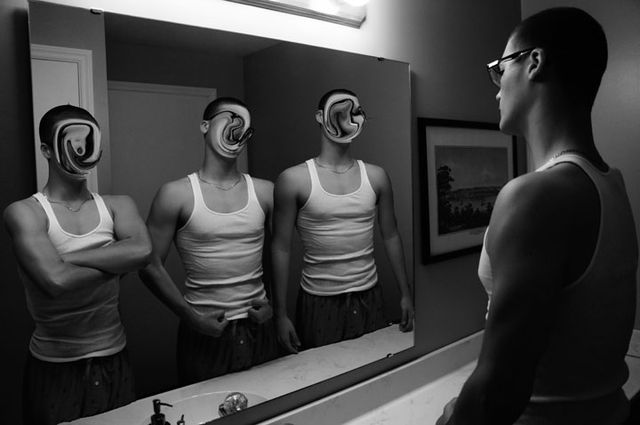
Among the arts, the poetry world appears to lead the field in this regard. Surely, the point of the arts is to escape oneself—to have a break from the mirror. Audiences and readers are looking for the character, not the actor or the author. Sadly, arts funding streams are forensic about the identity of applicants, and it’s hard not to conclude that artistic merit isn’t their priority.
Going through life behind an identity must be exhausting. Personally, I wouldn’t know where to start, and I’m too busy thinking about what it’s like not to be me. Identity isn’t an achievement anymore than it should be a hindrance. For writers and other artists, it’s a trap. We must relearn to separate the fruit from the tree.
 michaelcrowley.blog
Leave a comment